
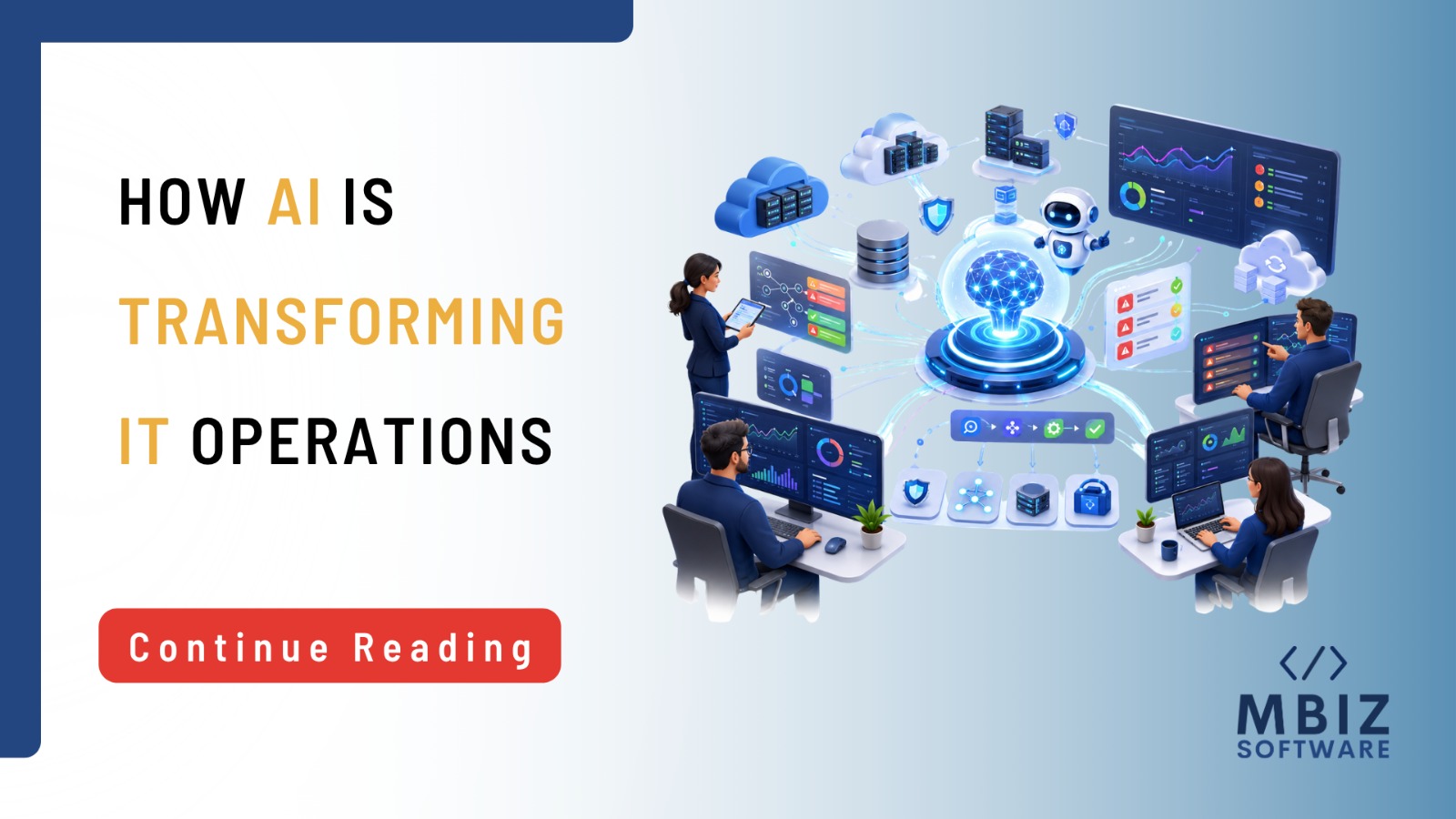
IT environments are becoming increasingly complex. Businesses now rely on cloud platforms, applications, networks, APIs, connected devices, and distributed infrastructure. Managing all these systems manually can make it difficult for IT teams to identify problems quickly and maintain reliable operations.
AIOps, or Artificial Intelligence for IT Operations, combines artificial intelligence, machine learning, automation, and IT operations data to help organizations monitor systems, detect anomalies, identify potential incidents, and automate repetitive tasks. In 2026, AIOps is becoming increasingly relevant for businesses looking to make IT operations faster, more proactive, and more scalable.
What Is AIOps?
AIOps stands for Artificial Intelligence for IT Operations.
It uses AI and machine learning technologies to analyze large volumes of IT data generated by applications, servers, networks, cloud platforms, security systems, monitoring tools, user activity, and IT service management platforms.
Traditional IT monitoring often requires teams to manually review alerts and investigate incidents. AIOps can analyze these signals together and identify patterns that may be difficult to detect manually.
Why Are Traditional IT Operations Becoming More Difficult?
Modern businesses generate enormous amounts of technology data.
A single organization may have multiple cloud environments, hundreds of applications, remote employees, multiple networks, SaaS platforms, security tools, databases, APIs, and connected devices.
Each system can generate alerts and operational data. The challenge is understanding which information matters. AIOps helps IT teams reduce this complexity by using AI-driven analysis and automation.
7 Ways AIOps Is Transforming IT Operations in 2026
1. Intelligent Monitoring
AIOps can continuously analyze infrastructure and application data and identify unusual behavior and anomalies.
2. Predictive IT Operations
AIOps platforms can analyze historical and real-time information to identify signals associated with potential system failures or performance problems.
3. Automated Incident Detection
AIOps can group related alerts and help identify whether multiple alerts are connected to the same underlying issue.
4. Faster Root Cause Analysis
AIOps can analyze relationships between systems, events, applications, and infrastructure to help identify possible root causes.
5. IT Automation
AIOps can automate repetitive operational tasks such as alert management, ticket creation, system responses, routine remediation, resource management, and incident escalation.
6. Improved Cloud Management
AIOps can analyze cloud performance, usage patterns, and resource behavior to help organizations identify inefficiencies and potential performance issues.
7. Better User Experience
AIOps can help organizations monitor application performance and identify problems that could affect users.
AIOps vs Traditional IT Monitoring
Traditional monitoring typically relies on predefined rules and thresholds. AIOps goes further by analyzing multiple data sources and identifying patterns.
Traditional monitoring is generally rule-based and reactive, while AIOps is more AI-driven, can correlate events, support dynamic anomaly detection, and enable automation.
AIOps does not necessarily replace traditional monitoring tools. Instead, it can enhance how IT teams use operational data.
How AIOps Helps IT Teams
AIOps can provide reduced alert fatigue, faster resolution, improved productivity, better visibility, and more proactive problem management.
AIOps and Cybersecurity
IT operations and cybersecurity are increasingly interconnected. AIOps can analyze unusual system behavior and operational signals that may indicate potential security issues.
However, AIOps should complement not replace – dedicated cybersecurity systems and security professionals. Organizations should maintain appropriate security monitoring, access controls, threat detection, and incident response processes.
Challenges of Implementing AIOps
AIOps implementation requires careful planning. Key challenges include data quality, integration with existing systems, skills, cost, and maintaining human oversight for critical decisions.
How Businesses Can Prepare for AIOps in 2026
1. Identify repetitive IT tasks.
2. Review existing monitoring systems.
3. Improve data quality.
4. Identify the most important operational KPIs.
5. Select suitable AIOps use cases.
6. Integrate AI gradually.
7. Monitor results.
8. Maintain human oversight.
The Future of AI-Powered IT Operations
Future IT operations will increasingly combine AI-powered monitoring, predictive analytics, automated remediation, intelligent incident management, cloud automation, security analytics, natural-language interfaces, and human expertise.
The goal is not simply to automate IT. The goal is to make IT operations more intelligent, proactive, efficient, and resilient.
How MBiz Software Can Support Modern IT Operations
As businesses adopt more complex technology environments, they need reliable IT expertise and operational support.
MBiz Software helps businesses access technology capabilities that can support digital transformation, IT operations, outsourcing, and business growth.
Businesses exploring AI-powered IT operations can benefit from assessing their current infrastructure, operational processes, monitoring capabilities, and automation opportunities before implementing an AIOps strategy.
Final Thoughts on AIOps in 2026
AIOps is changing the way businesses approach IT operations by combining AI, automation, analytics, and operational data.
For organizations managing increasingly complex technology environments, AIOps can help reduce alert fatigue, identify anomalies, improve incident management, automate repetitive tasks, and support proactive IT operations.
Successful implementation requires good data, suitable technology integration, clear objectives, and human oversight.
Frequently Asked Questions
What does AIOps stand for?
AIOps stands for Artificial Intelligence for IT Operations.
What does AIOps do?
AIOps uses AI and machine learning to analyze IT operations data, identify patterns, detect anomalies, correlate events, and support automation.
How is AIOps different from traditional monitoring?
Traditional monitoring often relies on predefined rules and thresholds, while AIOps can analyze multiple data sources and identify patterns or anomalies.
Can AIOps reduce IT downtime?
AIOps can help reduce the time required to detect, investigate, and respond to IT incidents, which can contribute to improved system availability.
Is AIOps suitable for small businesses?
It can be, depending on the complexity of the organization’s IT environment, available data, technology stack, and operational requirements.
Does AIOps replace IT professionals?
No. AIOps is designed to augment IT teams by automating repetitive tasks and providing insights. Human expertise remains important for decision-making and complex incidents.